Toolsheet 2 – Group coaching -The round table that really moves things forward

Toolsheet 2 – Group coaching -The round table that really moves things forward

£5.50

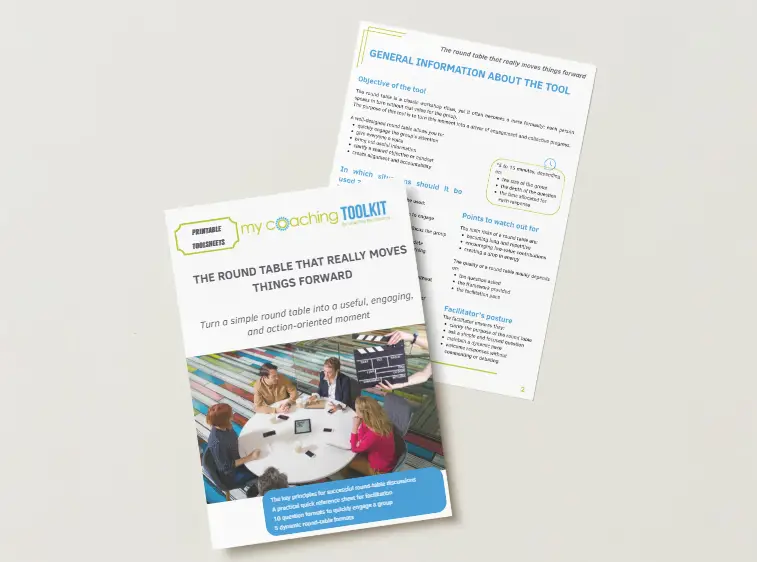
Toolsheet 2 – The round table that really moves things forward

This printable toolsheet “The round table that really moves things forward” helps you quickly unblock situations during sessions with simple and effective protocols, ready to use.

The “+” for coaches: 

  • Time-saving: you unblock the situation in a single sequence
  • High impact: you create a rapid breakthrough
  • Clarity of intervention: a structured and reassuring framework
  • Break out of inertia: you get the client moving again
  • Stronger posture: you guide without doing it for them
  • Visible results: the client leaves with a concrete first step 

Description :

Toolsheet 2 – Group coaching -The round table that really moves things forward


Toolsheet 2 – The round table that really moves things forward


Toolsheet 2 for your group/team coaching sessions: The round table that really moves things forward. A structured protocol that can be activated immediately in workshops


Facilitating a group workshop means constantly working with the group’s dynamics. 


Even with good preparation, certain situations frequently arise:

  • a check-in that brings no value
  • a group that keeps going in circles
  • difficulty in clarifying a shared objective
  • multiple or unclear expectations
  • scattered discussions
  • lack of a shared direction

 And very often, it all starts with the absence of a clear and shared objective. 


In these moments…

The coach must be able to quickly reset direction, align without imposing, structure without rigidifying, and bring convergence without flattening contributions… without improvising, while maintaining a high-quality framework. 


The answer: a toolsheet dedicated to effective Check-ins


The “The round table that really moves things forward” module was designed to transform an often-overlooked routine moment into a real facilitation tool.

A simple protocol to make every check-in useful, engaging, and action-oriented

The goal is to create momentum within the group. 


Content of the toolsheet 2 – Group coaching


This toolsheet provides a complete tool, ready to use in real-life facilitation situations.

1 – A clear presentation of the objective : Transform a check-in into a useful, engaging, and action-oriented moment


2 – General information about the tool 

  • duration (5 to 15 minutes)
  • contexts of use
  • benefits for the group
  • points of attention (question, framework, pace…)

3 – A detailed step-by-step guide – A 5-step method, with ready-to-use questions to be used directly in sessions: 

  • Clarify the intention
  • Ask a useful question
  • Set a clear framework
  • Launch and pace the check-in
  • Leverage the responses

4 –  A quick-reference guide for coaches – To facilitate easily in real time:

  • Golden rules of an effective check-in
  • Good reflexes
  • Pitfalls to avoid
  • Short and structured format

5 – Varied and dynamic formats – To adapt the tool to the group:

  • 10 question formats (keyword, scale, intention, etc.)
  • 5 dynamic check-in formats (weather, positioning, 3 words, lightning…)


Benefits for the coach 


This toolsheet serves as a practical facilitation reflex tool that enables you to: 

  • Effectively respond to low-impact check-ins: Transform a classic ritual into a lever for collective engagement
  • Gain fluency in facilitation: A clear framework (question, format, timing) prevents drift
  • Strengthen the impact of collective sequences: Responses become useful for the rest of the workshop
  • Create energy from the very first moments: A good check-in immediately mobilizes the group
  • Save time: Within 5 to 15 minutes, the coach gathers key information and activates the group
  • Strengthen your facilitation posture: The coach maintains the framework, pace, and intention without letting discussions drift 


Who is this toolsheet for ?


This toolsheet is particularly useful for:

  • professional coaches facilitating group workshops
  • collective intelligence facilitators
  • coaches in companies or organizations
  • consultants and trainers running participatory seminars

In what contexts should it be used ?


It is particularly suitable for:

  • At the beginning of a workshop to build participant commitment
  • during a transition to refocus the group
  • to bring out expectations or needs
  • to review collective progress
  • to close a workshop and reinforce key learnings


To go further

Discover the pack of 7 printable toolsheets – Group coaching 

Explore our series of 14 toolsheets for your individual and group coaching journeys 

Select your currency