Toolsheet 1 – Group coaching: Defining a shared group objective

Toolsheet 1 – Group coaching: Defining a shared group objective

£5.50

Toolsheet 1 – Defining a shared group objective

This printable toolsheet helps you quickly unblock challenging group situations using simple, effective, ready-to-use facilitation protocols. 

The “+” for coaches:

  • Time-saving: you unblock the situation in a single sequence
  • High impact: you create a rapid breakthrough
  • Clarity of facilitation: a structured and reassuring framework
  • Break out of inertia: you get the client moving again
  • Stronger facilitation presence: you guide without taking over
  • Visible results: the client leaves with a concrete first step

Description :

Toolsheet 1 – Group coaching: Defining a shared group objective


Toolsheet 1 for your group coaching sessions: Defining a shared group objective


Toolsheet 1 – group coaching: a short, structured protocol that can be activated immediately in workshops, allowing you to establish a clear and shared direction for the entire session in just a few minutes.

Facilitating a workshop means constantly working with the group’s dynamics.
 

Even with good preparation, certain situations frequently arise:

  • A group that keeps going in circles
  • Difficulty clarifying a shared objective
  • Multiple or unclear expectations
  • Scattered discussions
  • Lack of a shared direction

And very often, it all starts with the absence of a clear and shared objective.

In these moments…
The coach needs to quickly re-establish direction, align the group without imposing, provide structure without creating rigidity, and help participants converge without suppressing diverse perspectives.


The answer: a dedicated toolsheet for group alignment


The “Defining a shared group objective” toolsheet was designed to directly address this key situation: transforming individual expectations into a clear, useful, and engaging collective objective.


Contents of the toolsheet (Download)


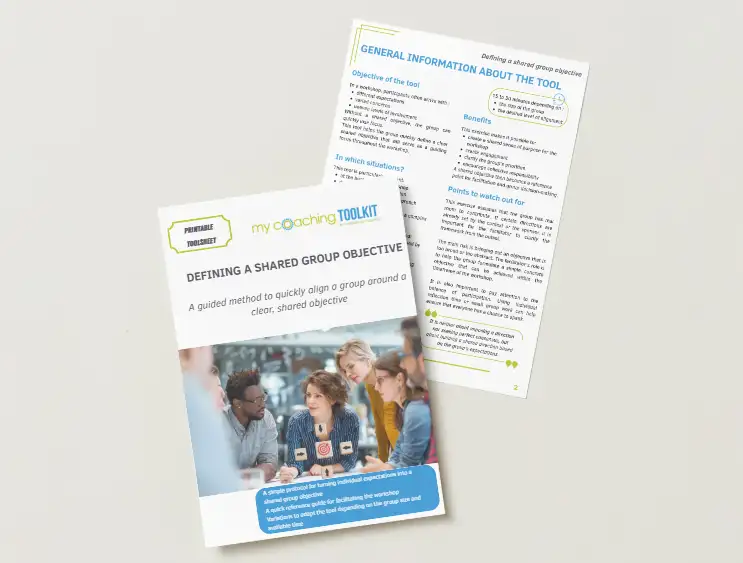
This toolsheet provides a complete facilitation resource that can be used immediately in real-life situations.

  1. A clear presentation of the objective – Understand when to use the tool and what it enables you to achieve: eliciting a clear and shared collective objective
  2. General information about the tool
    • Duration (15 to 30 minutes)
    • Contexts of use
    • Benefits for the group
    • Points of attention (overly broad objective, balance of participation…)
  3. A detailed step-by-step guide – A 5-step method, with ready-to-use questions to be used directly in sessions:
    1. Clarify the initial question
    2. Collect individual expectations
    3. Cluster ideas
    4. Define the collective objective
    5. Validate alignment
  4. A coach quick-reference sheet – To facilitate easily in real time:
    • Key steps
    • Golden rules
    • Pitfalls to avoid
    • Criteria for a good collective objective
  5. Facilitation variants – To adapt the tool to the context:
    • Convergence by voting
    • Work in subgroups
    • “Ideal objective” projection
    • Definition of concrete indicators


Benefits for the coach


This toolsheet works as a true facilitation reflex tool that enables you to:

  • Effectively respond to unclear workshop beginnings : Quickly clarify what the group truly wants to move forward on
  • Gain fluency in facilitation : A simple 5-step structure to guide the group without hesitation
  • Strengthen the impact of collective work: A shared objective becomes a reference point for exchanges and decisions
  • Create engagement from the start : Each participant contributes to building the common direction
  • Save time : In 15 to 30 minutes, the group moves from dispersion to alignment
  • Secure your facilitation stance : The coach relies on a clear framework while remaining a facilitator


Who it’s for


  • Coaches, trainers, and facilitators
  • Collective intelligence facilitators
  • Coaches in companies or organizations
  • Consultants and trainers running participatory seminars


In what contexts should it be used?


It is particularly suitable for:

  • At the beginning of a workshop or seminar
  • In a co-development session
  • In a collective intelligence process
  • When the group has to work on a complex topic
  • When expectations are multiple or unclear


What makes the difference?


  • A tool immediately usable in sessions
  • A short, dynamic and operational format
  • An approach focused on taking action
  • A powerful lever against inertia and procrastination
  • Printable, simple and effective materials


To go further


Discover the pack of 7 printable toolsheets – Collective coaching 

Explore our series of 14 toolsheets for your individual and group coaching journeys 
Select your currency