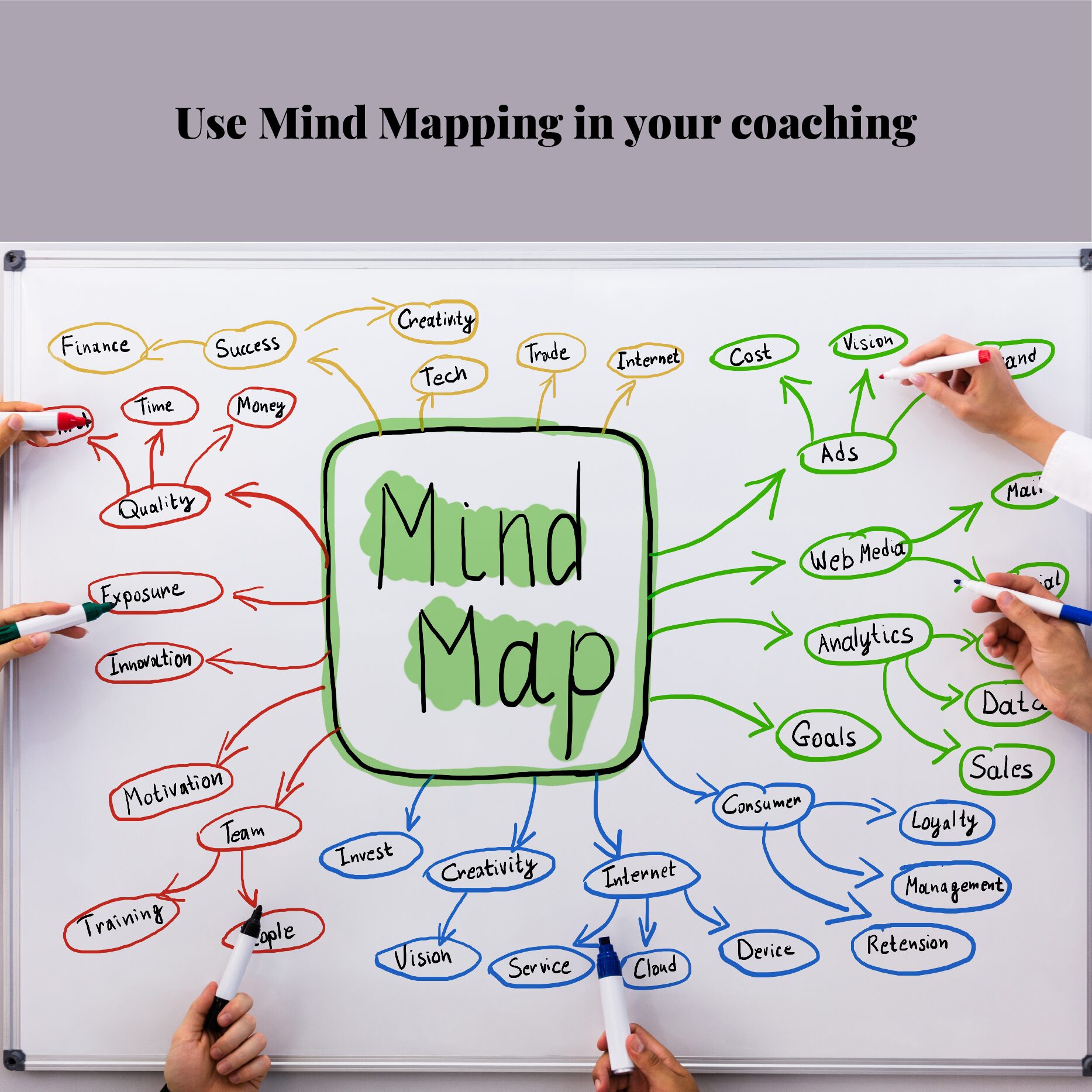
Mind mapping in your coaching practice: an e-book with worksheets for individual coaching and groups
A client tells you he no longer knows what he wants. His job is wearing him out, his team is pleasant and there is an offer for something new. You put an A3 sheet on the table, turned sideways, and ask him to write one word in the middle. He writes “direction”, draws a circle around it and adds the first branch. After a quarter of an hour there is something on the sheet that he could not yet have put into words.
That is how mind mapping works in a session, and this e-book describes how to do it. The map belongs to the client, and you ask the questions.
Five worksheets with timings per step
Worksheet 1 is an individual coaching conversation of 45 minutes, with room up to 60 minutes for going deeper. You choose a free variant, in which the client decides the main branches, or a guided variant with five fixed branches: current situation, obstacles, wishes, resources and first action steps. Worksheet 2 puts a GROW conversation of 45 to 60 minutes on one map, with questions for each branch.
Worksheet 3 is for a team or group working on one issue, such as collaboration or a plan for next year. It takes 60 to 90 minutes. Everyone first writes ideas on sticky notes in silence, so that the most vocal participants do not set the direction straight away. Then you build the map together, choose with dots what gets priority and divide the next steps for the coming two weeks.
For yourself as well
Worksheet 4 is a map with five fixed branches that lets you prepare a session in about 12 minutes. During the conversation you place it beside you. With the programme map you put a programme of four to six sessions on one sheet. Worksheet 5 takes about 20 minutes and helps you decide what you want to develop as a coach, with one step for this month.
What is inside
The e-book has 32 pages. The first chapter explains what mind mapping is, where the method comes from, who it suits and when to choose paper or software. After that come chapters on your role as coach and on building a map in five steps, on working with an individual client, on working with a group and on personal use. You will also find an example about personal health and wellbeing goals, an overview of symbols, questions for exploring a map together and three short exercises to get started. At the back are eight appendices to print: the blank maps for the worksheets, a session map and a programme map.
Honest about what mind mapping is
A mind map is a tool for exploring, reflecting and organising. It is not a diagnostic instrument and not a proven stand-alone coaching method, and you never interpret the map for the client. The e-book also explains why the idea that images and colour appeal to the right hemisphere finds no support in brain research, and when it is better to leave mind mapping aside.
Who this e-book is for
For coaches who work with individual clients or groups and want to add a visual technique to their sessions. You do not need any drawing talent. The e-book describes what to do when a client would rather not draw, and for each worksheet it shows how long it takes and which materials you need.
Frequently asked questions
- How long does a session with a mind map take? An individual conversation takes 45 to 60 minutes, a group session 60 to 90 minutes.
- Do I need software? No. Paper and pens are enough. The e-book compares maps on paper with digital maps, so that you can choose for yourself.
- Does my client need to be able to draw? No. It is about keywords, lines and colour, and the e-book describes what to do when a client does not want to draw.
- Is mind mapping a proven coaching method? No. It is a tool for exploring and organising, and the e-book is open about that.
- What do I receive after purchase? A Word file.