Toolsheet 7 – Group coaching : Three Positions, One Conversation

Toolsheet 7 – Group coaching : Three Positions, One Conversation

£5.50

Toolsheet 7 – Three Positions, One Conversation

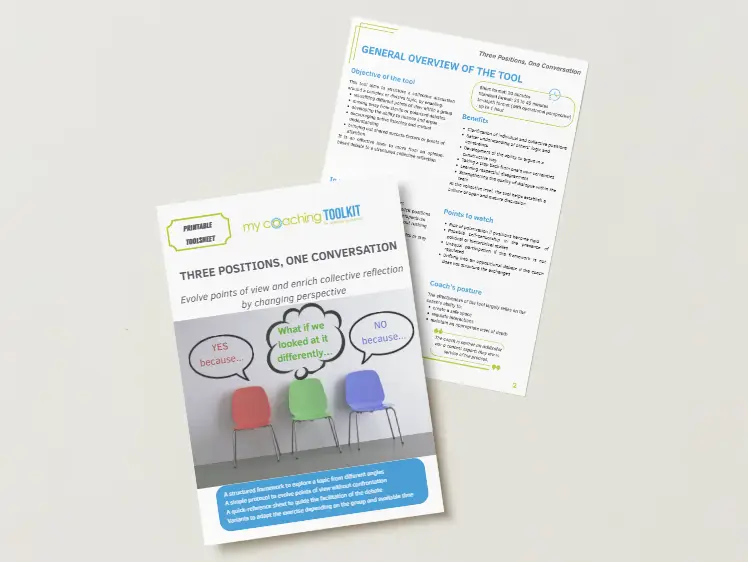
This printable toolsheet “ Three Positions, One Conversation ” helps you quickly unblock situations during sessions with simple and effective protocols, ready to use.


Key Benefits for Coaches:

  • Time-saving: you unblock the situation in a single sequence
  • High impact: you create a rapid breakthrough
  • Clarity of intervention: a structured and reassuring framework
  • Break out of inertia: you get the client moving again
  • Stronger posture: you guide without doing it for them
  • Visible results: the client leaves with a concrete first step

💡 Speak. Listen. Evolve.

Description :

Toolsheet 7 – Group coaching : Three Positions, One Conversation

 
Toolsheet 7 – Three Positions, One Conversation
 

Toolsheet 7 – Group  coaching: a short, structured protocol that can be activated immediately in workshops, allowing perspectives to evolve.


Facilitating a collective coaching workshop means constantly working with the group’s dynamics


Even with good preparation, certain situations frequently arise:

  • diverging opinions within the group
  • unspoken underlying positions
  • discussions that remain superficial
  • debates that turn into sterile opposition
  • difficulty nuancing perspectives
  • a lack of listening between participants

👉 And often, two risks emerge: the debate gets stuck… or becomes polarized.

In these moments…

The coach must be able to bring out different points of view, structure the discussions, encourage listening and nuance, and prevent confrontations… without imposing, arbitrating, or deciding in place of the group.


The answer: a toolsheet designed to structure discussions


The Three Positions, One Conversation ” toolsheet was designed to transform an exchange of opinions into a structured collective reflection: making different positions visible, encouraging constructive argumentation, fostering active listening, and helping perspectives evolve.

It helps move from an opinion-based debate to a rich and nuanced exploration process.


Content of the toolsheet 7 – Group coaching


This toolsheet provides a complete tool, immediately usable in real-life situations.

1 – A clear presentation of the objective – Structure a discussion around a complex topic by encouraging a diversity of perspectives.

2 – General information about the tool 

  • formats (20 min / 30–45 min / up to 1 hour)
  • contexts of use
  • benefits (dialogue, understanding, nuance)
  • points of attention (polarization, self-censorship…) 

3 – A detailed step-by-step guide – A structured method, with precise prompts to deepen, nuance, and bring perspectives into dialogue:

  • Set the framework and intention
  • Formulate an engaging issue or question
  • Organize positioning (For / Against / Undecided)
  • Bring out and structure the arguments
  • Synthesize and anchor the learnings

4 – A coach quick-reference sheet – To facilitate with accuracy and balance:

  • key steps
  • golden rules (listening, nuance, psychological safety)
  • positive signals (evolving positions, active listening…)
  • pitfalls to avoid (confrontation, superficiality, domination…)

5 – Facilitation variants – To enrich and adapt the exercise:

  • informed decision-making
  • professional stance
  • constrained argumentation
  • two-phase debate
  • active observers
  • reverse debate

To deepen reflection and strengthen collective impact


Benefits for the coach


This toolsheet works as a true facilitation reflex tool that enables you to: 

  • Clarify individual and collective positions. Make agreements, disagreements, and nuances visible 
  • Move beyond sterile debates. Structure discussions to avoid polarization 
  • Develop the quality of dialogue. Encourage listening, understanding, and nuance 
  • Encourage perspective-taking . Invite participants to question their certainties  
  • Facilitate decision preparation. Explore before deciding 
  • Secure the coach’s posture. Remain in service of the process, without intervening on the substance of the discussion 

Who is this toolsheet for?


This toolsheet is particularly useful for: 

  • professional coaches facilitating group workshops
  • collective intelligence facilitators
  • coaches in companies or organizations
  • consultants and trainers supporting decision-making processes

In what contexts should it be used?


It is particularly suitable for: 

  • when a topic generates divergent viewpoints
  • when a team needs to clarify its positions
  • in preparation for a decision-making process
  • when the group avoids sensitive topics
  • to stimulate participation and collective reflection 

⚠️ To adapt if:

  • the level of tension is already high
  • the psychological safety framework is insufficient
  • power dynamics are influencing psychological safety and participation

an urgent decision must be made immediately
What makes the difference


  • A tool immediately usable in sessions
  • A short, dynamic and operational format
  • An approach focused on taking action
  • A powerful lever against inertia and procrastination
  • Printable, simple and effective materials 
Select your currency